
Mirrors, Murder, and Magic Sheets
Plus: R+J @ 30
This newsletter has footnotes.1 If you prefer not to scroll down, click on the email headline to read in-browser and they will appear when you click on them. I use open access and gift links whenever possible, however you may still encounter paywalls. There are options. If you enjoy this newsletter, please share it and consider pledging a future subscription.
Quick Links
Why Are Theater Tickets So Much Cheaper in London Than New York?
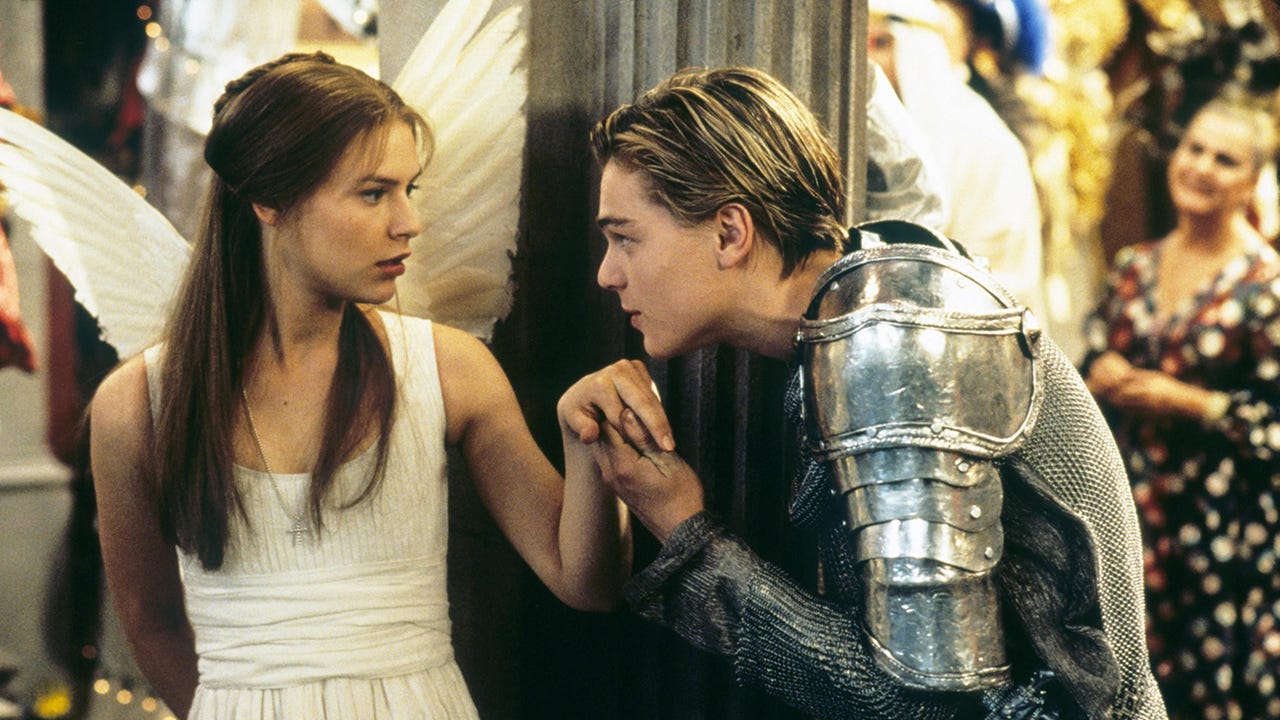
Last season, “Romeo + Juliet,” whose stars — Kit Connor and Rachel Zegler — appealed to young audiences, charged $1,478.50 for the best seats in its final days.
“I’d love to do a female Hamlet. I think that’d be so fun. Well, not ‘fun’, really, but you know…”
“What biscuit would your character be?” (R&J edition)
“Hamlet, while an excellent play, is not a good stand-up set.”
Natalie Kimmerling wins our affection as his daughter Katherine, yet it’s hard to understand why her lesson in English vocabulary now takes place over the bodies of wounded soldiers who groan and wince every time she prods at different parts of their bodies.
“The fact that it’s Shakespeare that I’m winning for feels important.”
Ivo van Hove’s Roman Tragedies as an example of “all theatre should be less than two hours or more than five.”
Ayad Akhtar’s Keynote at the Milwaukee Theater Leader Summit. (more + report)
Joe Papp was a trainer of “audiences” par excellence. He put Shakespeare in Central Park and made it free. When Robert Moses tried to force him to charge admission, Papp fought him publicly and won. The principle wasn't charity—it was a conviction that the audience for serious theater was vastly larger and more diverse than anyone assumed, and that the barrier was access, not taste.
American Theatre Magazine remembers playwright Don Nigro, “the finest playwright you never heard of.” His work includes The Curate Shakespeare As You Like It, Sycorax, The Owl Was a Baker’s Daughter, and Henry and Ellen.
Sara Bruner interviewed by Lue Douthit in SDC Journal:
One essential thing for me with Shakespeare plays is that we try to approach them like they’re brand new...Eva Le Gallienne famously went into rehearsal for “Romeo and Juliet,” sat down, and said, “This is a new play by a new playwright, it’s called ‘Romeo and Juliet’ by William Shakespeare.”
“The Summer Oath,” an audio adaptation of Love’s Labor’s Lost starring Maya Hawke comes out next month.
“Look, one of the things that you could do now that will escape you in five years is Juliet.”
Ian McKellen on what Shakespeare teaches.
I am capable of murder. I now realize because I’ve imagined what it’s like to be Macbeth and I realize I am capable of that. Doesn’t mean to say I do it, but I’m capable of doing it.
Betsy Golden Kellem on 19th c. theater.
The most popular Shakespearean roles for women in the tragic repertoire were Romeo and Hamlet, but women also played Macbeth, Cardinal Wolsey, Shylock, Richard III, and Iago.
“You wouldn’t necessarily think As You Like It and King Lear are in tight conversation with each other, but they are.”
John Payne Collier’s faked Second Folio + Nina Conti on the RSC.
I was furniture really. I was called play-as-cast which means you just sort of get the odd bit to do. I did play Audrey in “As You Like It” …and I was the Courtesan in “Comedy of Errors” …I didn’t have very much to do on stage and that did make me mischievous and it did make me want to do something more and that’s when I became a ventriloquist actually.
At least the Kennedy Center closing is having some knock-on good?
A spokeswoman for the Shakespeare Theater Company, not far from the White House, said that it was on pace to have one of its highest-selling seasons ever…
You can’t make him a kind of nakedly ambitious fascist kind of stereotype. Otherwise, you take away all the complexity and difficulty of Brutus’s decision.
Matt Lewis argues for the Richard III-as-Cecil theory.3 via Made by History
Ultimately, Richard is the architect of his own demise, and I believe that Shakespeare was offering a warning that Robert Cecil would become the architect of the downfall of the Tudors, and that Elizabeth was allowing it to happen.
Emma Smith on Richard Oswald’s rare books. (who?)
…because unlike many provenance names, Oswald’s is distinctive, it is everywhere from large to small institutions, in digital archives, through the auction houses and book dealers. It is like a dye trace in the special collections’ water system. And because it is so ubiquitous, it offers a new model for considering the legacies of the past in the present.
This isn’t a tiny violin problem for places like the Folger Shakespeare Library or the Huntington, although they’re also included in its reach. Oswald’s books offer instead a snapshot of how collections and systems of value created by, paid for by, the slave economy have percolated across our libraries and special collections almost invisibly, but there in plain sight.
Shakespeare at Notre Dame does Texas.
…as Jo, Benjy and I were in the midst of the banishment scene I realised that the student who had worked on it and performed it in the curtain-raiser earlier were mouthing the lines along with us, like Shakespearean karaoke.4
Current Hamlet Ralph Davis was a child actor at the RSC in King John and Richard III.
Jeffrey Sweet on Jules Feiffer’s play, The White House Murder Case in The Dramatist Quarterly:
I always wanted somebody to run that in rep with my favorite underestimated Shakespeare, “King John,” which predicts Richard Nixon.
Shakespeare and the streetlight effect via Dead Language Society.
Annotated scripts are the best.
The most surprising thing to be revealed is that I’m surprised to be loved.
Recommendations
Like this one.

Yes to keeping the scrivener.