
Steadicams, Sports, and Show Stops
Plus: All the Macbeths: pop, drag, “Friends”, ha ha, therapy, lipstick
This newsletter has footnotes.1 If you prefer not to scroll down, click on the email headline to read in-browser and they will appear when you click on them. I use open access and gift links whenever possible, however you may still encounter paywalls. There are options. If you enjoy this newsletter, please share it and consider pledging a future subscription.
Quick Links
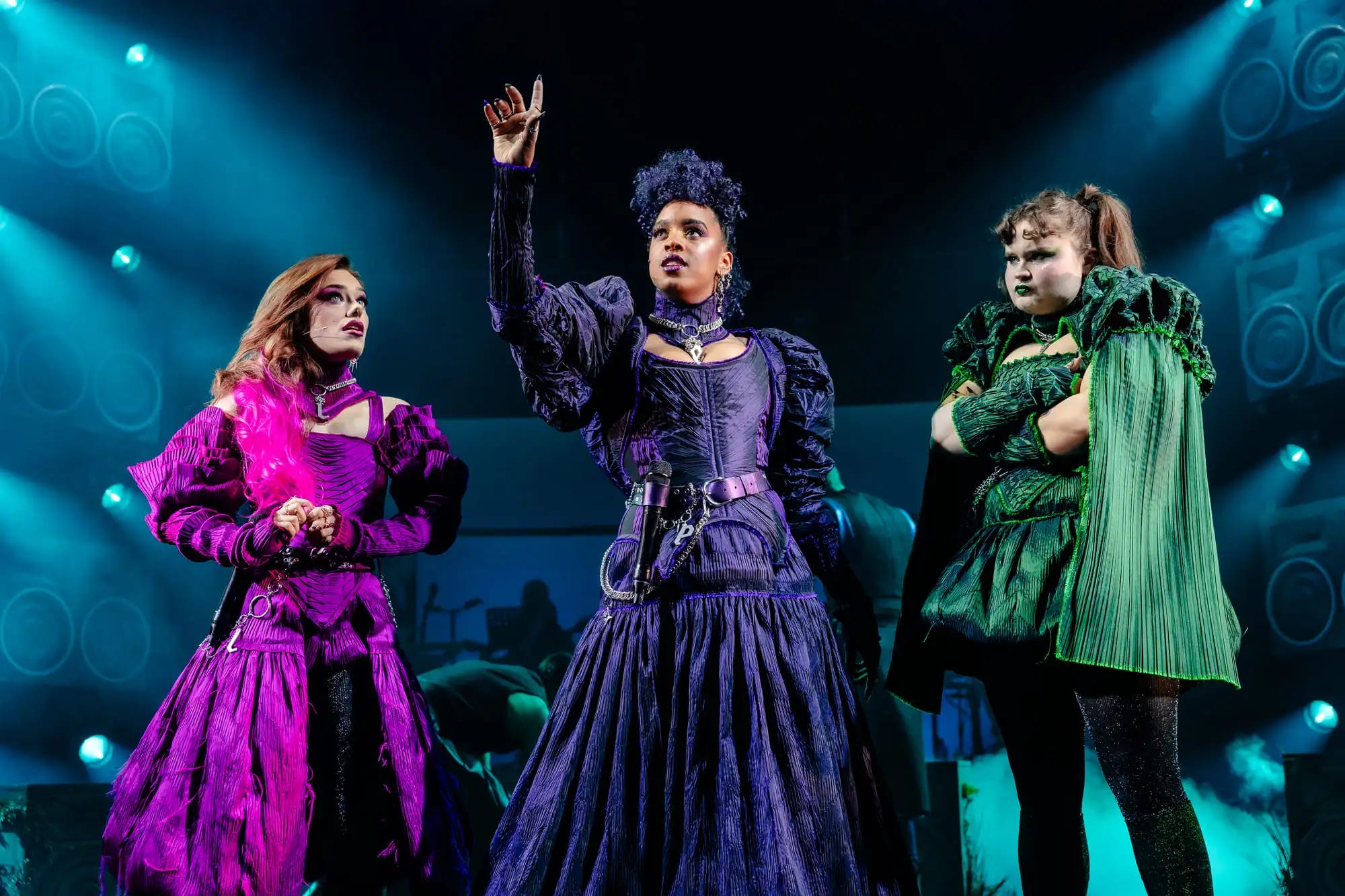
Auditioning for Macbeth retold as an episode of Friends is a thing you can do.2 (archive)
Macbeth in Minneapolis roundup: No Porter = Seyton gets the funny + more.
We did a talkback the other day, and a lot of audience members were very emotional, especially with everything that's going on in our community with ICE and people being kidnapped and deported, and this play definitely explores all of that and the effects that one or a couple of individuals' actions can have on an entire country.
Related: the MAC Lip Bar for Macbeth where you can get a “complimentary lipstick application by MAC artists inspired by the fearless style of Lady Macbeth” is genius.
Macbeth as “couples therapy.” (oh. oh no.)
It’s been a funny household here. We’ll be cooking dinner, chopping vegetables, and saying, “Screw your courage to the sticking place!”
Look, as long as Nora Polley keeps talking, I’m going to keep sharing. Previous + new thoughts on Plummer’s Lear, grumpy Malcolms, understudies, show stops + student matinees, drunk actors, and Lear announcing the Russia-Canada hockey score during the storm scene (1972).
Kenneth Branagh, Alfred Enoch, Alex Hassell and Tamara Harvey talk Henry V.
So welcome the ghosts. Welcome the ghosts. I mean, you could almost weep when you think of the people who’ve walked on that stage.
Emma Smith makes a persuasive argument for Twelfth Night.3
…the hope embedded in the comedies and the so-called romances is that what is lost or wrecked can be recovered or remade…That prefix “re” is really in some ways the kind of syntax of comedy…perhaps our cultural preference to spectate disaster, the aesthetic of tragedy, should be replaced, at least for a short time, by a preference for recovery, the narrative art of comedy.
…what I want to suggest about Twelfth Night is that it is its unsettledness and its acceptance of imperfection and compromise as a feature of individual humans and the societies they create is its predominant claim on our modern attention.
“In the script, Jerry writes they intended this piece to be a rewrite of Richard II minus the plot and that character.”
Sports reporting for the Washington Post.
At the end of every Olympics, our editor Tracee Hamilton would crack open a Guinness and recite the St. Crispin’s Day speech from Henry V, about “we happy few.” We laughed so hard that the New York Times staffers sitting in their office beyond a plywood wall would shush us—for which we would toss pencils at them.
An evening of music including original compositions from the Globe and RSC + songs from *two* Henry VIIIs (two more than I’ve seen) + Mrs. Patmore via @itseleanorgrant.
George Saunders on Ezra Klein:
In the best of Shakespeare, what you feel is a god’s eye view of someone going: Whoa, this is amazing — without tilting the board based on your own viewpoint. The vastness that you feel in him.
Colin Gorrie on “wyrd”/”weird” via Culture Study
…people sort of – I wouldn’t say misinterpret – but they reinterpret what “weird sisters” means, because really what “weird sisters” meant at the time was the “sisters of fate”, “the sisters who control destiny.” But they were a bit weird as well.
Hamnet’s Hamlet would like you to know that he is all grown up.
Jonathan Bate on hamartia. via Jonathan Bate
…the passage has repeatedly been taken as a moment of self-diagnosis, a tacit acknowledgement of Hamlet’s own fatal flaw. Yet this reading rests on surprisingly fragile foundations. The “vicious mole” passage appears in the Second Quarto but was cut from the Folio text, the version of the play most closely associated with theatrical performance. Its absence suggests that Shakespeare, or the acting company, did not regard it as structurally or thematically indispensable.
Cameos at Southern Shakespeare Company. (more)
Sometimes, the cameo is tailored specifically to the individual. During "Antony & Cleopatra," the role was personalized for each night’s guest. When Philo addressed Dr. Jai Vartikar, First Lady of Florida State University, as “FSUvius,” the student-heavy audience erupted with cheers — a moment that could only have happened in Tallahassee.
A luminous, pearly vapor having the form of a man emerged from the southwest room on the lower floor…it wore a stiff straw hat set jauntily, a light suit and carried a cane. It floated down the long corridor…and wailed in a voice itself the ghost of the vocal: "To-morrow and to-morrow and to-morrow creeps in this petty pace from day to day," and so on to the end.
Edward Saxon had put together a casting memo in May 1989, naming 75 potential candidates for the character. The list was a wide-ranging, spitballing assortment of late-1980s male performers, including David Bowie, Harrison Ford, Robin Williams, Charles Grodin, Steve Martin, Tom Hanks, Jeremy Irons, Al Pacino, Bill Murray, and Warren Beatty. Demme was also apparently interested in an English stage actor named Edward Petherbridge, who’d starred in the original London production of Rosencrantz and Guildenstern Are Dead…
A deep-dive on the Mellon Foundation.
Under Alexander’s leadership…Mellon has disbursed enormous sums of money to hyper-liberal academic initiatives at institutions both public and private. These have included grants…to Texas A&M at San Antonio for the Borderlands Shakespeare Colectiva…
…Even before its recent pivot, Mellon tended to tilt to the left…But although some of its endeavors through the years were expressly social-justice-oriented (such as a 2016 grant for Columbia’s “Facing Whiteness” project, an interdisciplinary study of how white Americans think about their racial identity), others were more traditional (a long-standing relationship with the Folger Shakespeare Library, for example).
Recommendations
Like this one.
Available roles include Chandler/Macbeth, Monica/Lady M, and Rachel/Banquo. The latter includes “a passionate kissing scene and some light stunt work.” (p.s. the previous art institutions housed at Serenbe have a complicated history.)
Also, please enjoy the sadly silent but somehow still outrageously loud academic gossip that happens when the talk is done but the camera stays on.
But yes towels.
